
Bitcoin is a form of digital money that allows people to send and receive value over the internet without relying on a bank or other central financial institution. Introduced in 2009 by an unknown person or group using the name Satoshi Nakamoto, Bitcoin was the first decentralized cryptocurrency to achieve global adoption and remains one of the best-known applications of blockchain technology.
Unlike traditional currencies such as the U.S. dollar or euro, Bitcoin is not issued or controlled by a central bank. Instead, it operates through a decentralized network of computers located around the world. These computers collectively maintain Bitcoin’s transaction history and enforce the rules of the system.
The Blockchain
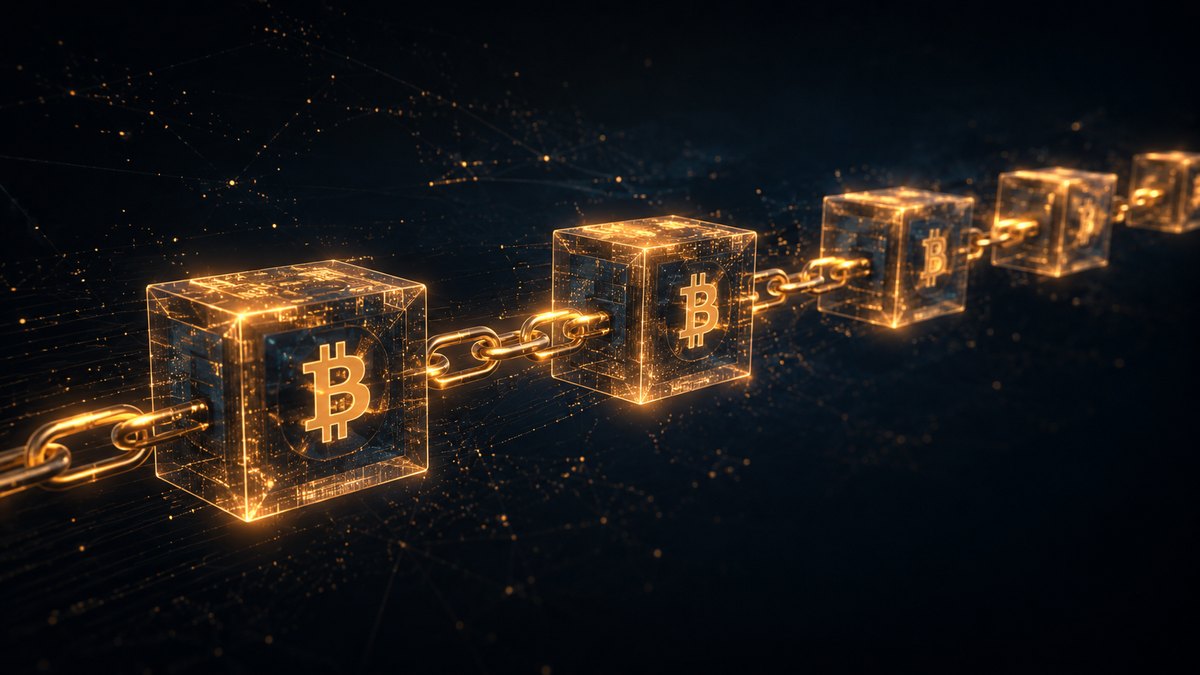
At the heart of Bitcoin is a technology called the blockchain. A blockchain is essentially a shared digital ledger—a record containing Bitcoin transactions.
Transactions are grouped together into units called blocks. Each block is cryptographically connected to the block before it, creating a chronological chain. This structure makes altering old records extremely difficult because changing a past block would conflict with the later blocks and the records maintained by the rest of the network.
Thousands of computers, known as nodes, can independently store and verify Bitcoin’s transaction history. Rather than trusting one organization to maintain the official ledger, participants can verify that transactions follow Bitcoin’s rules themselves.
How a Bitcoin Transaction Works
Suppose Alice wants to send bitcoin to Bob. Alice uses a Bitcoin wallet to create a transaction identifying bitcoin she controls and specifying where it should be sent.
Bitcoin wallets use public-key cryptography. A wallet manages private keys, which allow the owner to authorize transactions. The transaction is digitally signed using the appropriate private key, providing mathematical proof that the person controlling that key authorized the transaction without revealing the key itself.
The transaction is then broadcast to the Bitcoin network. Nodes check whether it follows Bitcoin’s rules—for example, whether the digital signature is valid and whether Alice is attempting to spend bitcoin that has already been spent.
Valid transactions can then be included in the blockchain.
Mining and Proof of Work
Bitcoin uses a system called proof of work to determine how new blocks are added to the blockchain.
Participants called miners use specialized computers to repeatedly perform calculations in an attempt to find a valid solution for the next block. Finding one requires substantial computational work, but other computers can verify the result quickly.
The miner that successfully produces a valid block can receive newly created bitcoin through the block subsidy. The block may also include transaction fees paid by users whose transactions are included. Together, the block subsidy and transaction fees are often described as the block reward.
This process serves two important purposes: it helps secure the network and provides a mechanism for introducing new bitcoin into circulation.

Why Is Bitcoin Limited to 21 Million?
One unusual feature of Bitcoin is its predetermined supply policy. Its protocol limits the total amount that can ultimately exist to 21 million bitcoin.
Bitcoin’s block subsidy is periodically reduced in an event commonly called the halving. Approximately every four years, the amount of newly issued bitcoin available through the block subsidy is cut in half. Transaction fees are separate and are not reduced by the halving. As a result, the rate at which new bitcoin enters circulation decreases over time.
This scarcity is one reason Bitcoin is sometimes compared with gold, although Bitcoin and gold have very different properties and risks.
What Gives Bitcoin Value?
Bitcoin does not represent ownership of a company or a claim on physical assets. Its market price is determined primarily by supply and demand.
People may value Bitcoin for several reasons. It can be transferred internationally, its supply rules are predictable, ownership can be held without a traditional bank account, and transactions can occur without requiring permission from a central operator. Some people therefore view Bitcoin as a potential store of value, while others use it primarily as a speculative asset or as a payment and settlement network.
These characteristics do not guarantee that Bitcoin will retain or increase its value. Its market price can rise and fall dramatically.
Is Bitcoin Anonymous?
Bitcoin is better described as pseudonymous than completely anonymous.
Bitcoin transactions are recorded on a public blockchain, meaning anyone can examine the movement of bitcoin between addresses. Addresses do not automatically display a person’s real-world identity, but transactions can sometimes be connected to individuals through exchanges, payment records, blockchain analysis, or other information.
Users should therefore not assume that Bitcoin transactions are private.
How Do People Store Bitcoin?
Bitcoin itself does not sit inside a wallet in the same way that cash sits inside a physical wallet. The blockchain records which bitcoin can be spent under particular conditions, while a Bitcoin wallet manages the private keys needed to authorize spending.
Wallets can take several forms, including mobile and desktop applications, hardware devices, and services operated by cryptocurrency exchanges.
Protecting private keys is extremely important. If someone obtains a user’s private key or recovery information, they may be able to steal the associated bitcoin. Conversely, permanently losing the information needed to access a wallet can make its bitcoin effectively inaccessible.

Advantages and Risks
Bitcoin’s decentralized structure gives it several unusual characteristics. It can operate without a central bank, transactions can cross national borders, and the system’s monetary rules can be independently verified through its open protocol.
However, Bitcoin also carries substantial risks. Its price is highly volatile, transactions generally cannot simply be reversed after they are confirmed, scams and theft occur throughout the cryptocurrency ecosystem, and improperly secured private keys can be lost or stolen. Cryptocurrency regulations and tax treatment also vary by jurisdiction and can change over time.
Bitcoin’s proof-of-work mining process additionally consumes significant amounts of electricity, making its environmental impact an ongoing subject of debate.
The Bigger Picture
Bitcoin introduced a significant idea: two people who do not necessarily trust each other can transfer a scarce digital asset without requiring a central institution to maintain the authoritative ledger.
It achieves this by combining technologies and concepts including cryptography, decentralized networking, blockchain records, economic incentives, and proof of work.
Whether Bitcoin ultimately becomes primarily a store of value, a global settlement system, a speculative asset, or something else remains uncertain. But its influence is already substantial. Bitcoin demonstrated that decentralized digital money could function at a global scale and helped inspire the broader cryptocurrency and blockchain industry.
Understanding Bitcoin therefore involves more than understanding a new type of currency. It provides an introduction to a different way of thinking about digital ownership, trust, and the transfer of value on the internet.
From Bitcoin Mining to Bitcoin Block Panning
Traditional Bitcoin mining is often discussed in terms of operating mining hardware directly or contributing computing power through a mining pool. Minerium’s Bitcoin Block Panning (BBP) model takes a different approach: a participant, referred to as a prospector, accesses a defined time-slice of real Bitcoin mining power for a specific session rather than owning or purchasing hosted mining equipment.
Block discovery is probabilistic. A BBP pan does not guarantee that a valid block will be discovered or that a reward will be generated. A session can end without a block discovery.
As described above, a Bitcoin block can include both a block subsidy and transaction fees. A BBP participant’s entitlement is defined by Minerium’s current BBP Terms and Product Rules; readers should not assume that every component associated with a mined block is paid to the participant.
For current product details, readers should also review the official BBP FAQ, the Minerium FAQ, and the Minerium Trust & Verification Center.
Educational disclaimer: This article is for general educational purposes only and does not constitute investment, financial, legal, or tax advice. Bitcoin and Bitcoin mining involve risk, and outcomes are not guaranteed.